
Introduction to Python static methods
So far, you have learned about instance methods that are bound to a specific instance. It means that instance methods can access and modify the state of the bound object.
Also, you learned about class methods that are bound to a class. The class methods can access and modify the class state.
Unlike instance methods, static methods aren’t bound to an object. In other words, static methods cannot access and modify an object state.
In addition, Python doesn’t implicitly pass the cls parameter (or the self parameter) to static methods. Therefore, static methods cannot access and modify the class’s state.
In practice, you use static methods to define utility methods or group functions that have some logical relationships in a class.
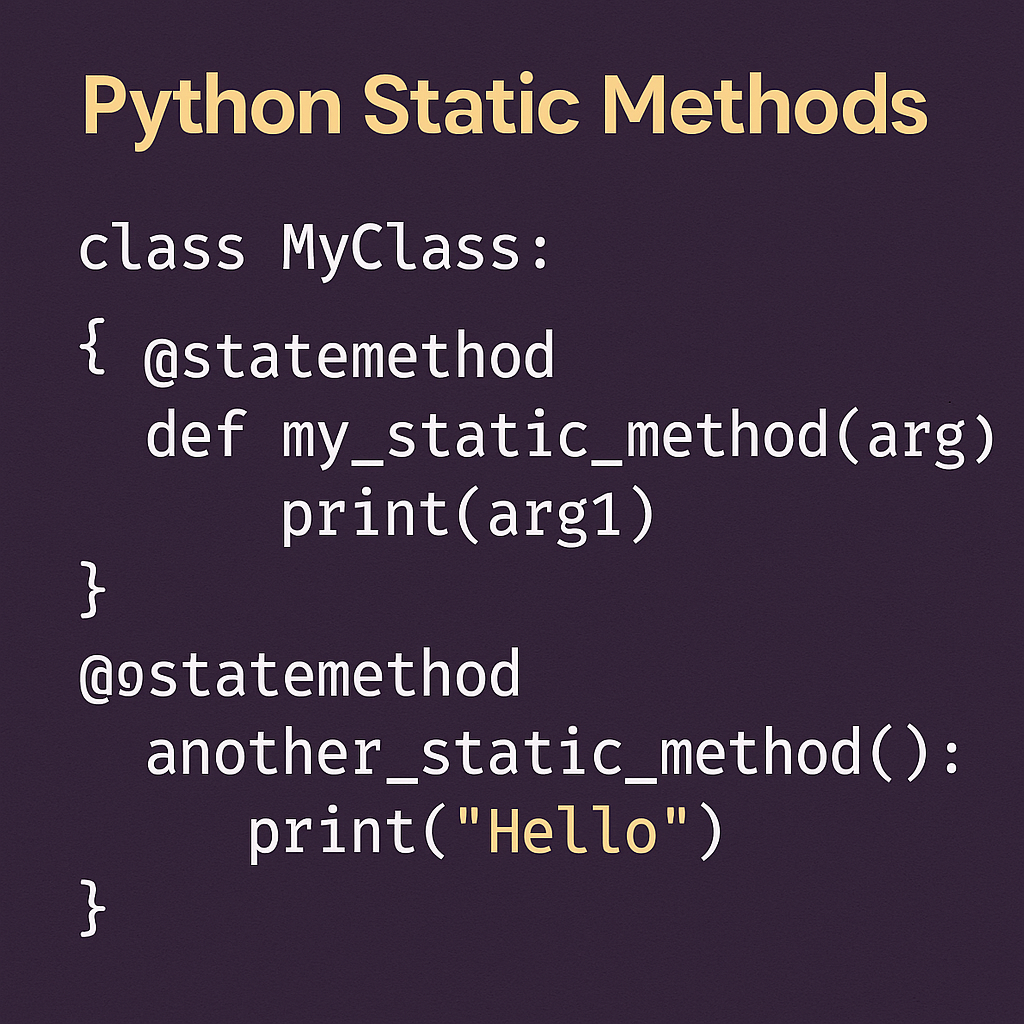
To define a static method, you use the @staticmethod decorator:
Key characteristics of static methods:
- No instance or class access:
Static methods cannot access or modify instance-specific data (using self) or class-specific data (using cls).
- Called on the class:
They can be called directly on the class itself, without needing to create an instance of the class.
- Utility functions:
They are commonly used for utility functions or operations that are logically related to the class but do not depend on the state of any particular object or the class itself.
Example :
class className:
@staticmethod
def static_method_name(param_list):
pass
To call a static method, you use this syntax:
className.static_method_name()
Python static methods vs class methods
Since static methods are quite similar to the class methods, you can use the following to find the differences between them:
| Class Methods | Static Methods |
| Python implicitly pass the cls argument to class methods. | Python doesn’t implicitly pass the cls argument to static methods |
| Class methods can access and modify the class state. | Static methods cannot access or modify the class state. |
| Use @classmethod decorators to define class methods | Use @staticmethod decorators to define static methods. |
Python static method examples
The following defines a class called Temperature Converter that has static methods for converting temperatures between Celsius, Fahrenheit, and Kelvin:
Example :
class TemperatureConverter:
KEVIN = ‘K’,
FAHRENHEIT = ‘F’
CELSIUS = ‘C’
@staticmethod
def celsius_to_fahrenheit(c):
return 9*c/5 + 32
@staticmethod
def fahrenheit_to_celsius(f):
return 5*(f-32)/9
@staticmethod
def celsius_to_kelvin(c):
return c + 273.15
@staticmethod
def kelvin_to_celsius(k):
return k – 273.15
@staticmethod
def fahrenheit_to_kelvin(f):
return 5*(f+459.67)/9
@staticmethod
def kelvin_to_fahrenheit(k):
return 9*k/5 – 459.67
@staticmethod
def format(value, unit):
symbol = ”
if unit == TemperatureConverter.FAHRENHEIT:
symbol = ‘°F’
elif unit == TemperatureConverter.CELSIUS:
symbol = ‘°C’
elif unit == TemperatureConverter.KEVIN:
symbol = ‘°K’
return f'{value}{symbol}’
And to call the TemperatureConverter class, you use the following:
f = TemperatureConverter.celsius_to_fahrenheit(35)
print(TemperatureConverter.format(f, TemperatureConverter.FAHRENHEIT))
Example 2:
class MathUtils:
@staticmethod
def square(number):
return number * number
@staticmethod
def factorial(n):
if n == 0:
return 1
else:
return n * MathUtils.factorial(n – 1)
# Calling static methods
print(MathUtils.square(5))
print(MathUtils.factorial(4))
Summary
- Use static methods to define utility methods or group a logically related functions into a class.
- Use the @staticmethod decorator to define a static method.